
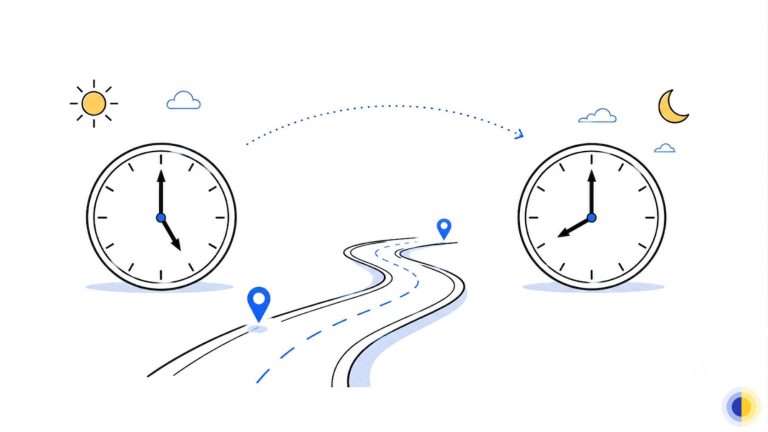
21st Century Time Travel
If you like road trips, you might have considered the journey from Atyrau, in Kazakhstan at the northern end of the Caspian Sea, to Shanghai. With a few zigzags, you head east-south-east and, 8,000 km (5,000 miles) later, you’re on the east coast of China.
Along the way, you’ll pass disparate climate zones and numerous local languages. But you’ll only cross one border and one time zone.
Kazakhstan and China share an 1,800km (1,100 mile) border. They’re also two of the largest countries in the world that employ a single official time zone. Kazakhstan is 5 hours ahead of Universal Time and China 8 hours. This has the bizarre effect that when you cross the border, you’ll experience a 3-hour time change.
China’s time zone is set for the convenience of those in political power, who mostly live near the east coast. In western China, the mid-winter sun doesn’t rise until after 10:15am. The locals have adapted by creating an unofficial time zone that is two hours closer to Kazakhstan, but it seems to be used inconsistently.
If you’re keen to experience this 21st century equivalent of time travel but don’t want to go into China from Kazakhstan, you can also do it from Tajikistan or Pakistan. None of these countries, however, hold the record—that belongs to Afghanistan, which is 3 ½ hours different than China. They share an 80km (50 mile) border, but they don’t have a land crossing, so if you do make the journey you should probably keep quiet.
Next week: Another interesting aspect of China’s single time zone.
📄 Explore our product:
🔗 Time Zones – Easily convert past or future dates and times around the world
📨 For more information, contact us at: info@swapsmonitor.com