24/5 Trading: Where Do We Stand Today?

The conversation around 24/5 trading continues to gain momentum, but the data suggests we’re still some way from a truly round-the-clock market. 

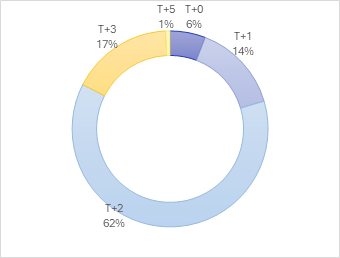
Across the 2,900+ cash equity and derivatives markets we cover, fewer than 40% currently offer 20 hours or more of trading per weekday, while just 2% provide 24-hour trading. 

Notably, extended-hours trading remains entirely a derivatives story. Of all markets offering 20+ hours of trading, 88% are futures contracts, with the remainder consisting of options markets. 

From a regional perspective, North America leads the shift toward extended trading hours, followed by Europe and Asia.  

As exchanges continue to explore longer trading windows, Swaps Monitor tracks every market update as it happens, ensuring our data evolves alongside the markets themselves. 

Anticipate. Plan. Trust. 


📄 Explore our products: 

🔗 Holidays – Correctly anticipate future holidays
🔗 Trading Hours – Know your trading window, down to the second 
🔗 Expiry Dates – Never miss a deadline
🔗 Economic Events – Keep current on economic events

📨 For more information, contact us at: info@swapsmonitor.com 

Beyond Standard Hours: Capturing Temporary Trading Sessions

Market disruptions can lead to unexpected changes to the trading day. 

On July 28, following a halt in the cash equities market, Bourse de Tunis introduced a temporary session where participants could cancel orders—but nothing else. The exchange does not normally have such a session and the next day, when it had another halt, it repeated the tactic. 

In recent years, similar temporary sessions have taken place on Shanghai-Hong Kong Stock Connect and the Moscow Exchange.  

At Swaps Monitor, we capture what happened, not merely what was expected. That’s why our Trading Hours data incorporates these temporary sessions, including the specific activities permitted during each one, with the same precision and granularity as regular market schedules. 

Plan. Anticipate. Trust. 


📄 Explore our products: 

🔗 Holidays – Correctly anticipate future holidays
🔗 Trading Hours – Know your trading window, down to the second 
🔗 Expiry Dates – Never miss a deadline
🔗 Economic Events – Keep current on economic events

📨 For more information, contact us at: info@swapsmonitor.com 

Is the Calendar a Reason Why China has Only One Time Zone?

If you google the question, “Why does China have only one time zone?”, you’ll get a response to the effect that it promotes national unity and centralized administration while preventing regional confusion and standardizing work and broadcast schedules.

We would like to suggest another reason: The calendar.

The Chinese calendar is geo-specific. In other words, it matters where on earth you are, and in particular what time zone you’re in.

The first day of each month in the Chinese calendar is, by definition, the day of the new moon. For example, in 2007 the new moon fell on February 18 at 14 minutes after midnight, Beijing time. As a result, the date of Chinese New Year was February 18.

In Vietnam, Tet, the new year, is calculated according to the same calendrical rules. But since Vietnam’s clocks are an hour behind China, the new moon fell on February 17 at 11:14pm and Tet was observed one day earlier on the 17th.

And therein lies a reason for China to have a single time zone—doing otherwise would mean that in certain years the new year would start on different days in different parts of the country. Presumably, an undesirable outcome.


📄 Explore our products: 

🔗 Holidays – Correctly anticipate future holidays
🔗 Trading Hours – Know your trading window, down to the second 
🔗 Expiry Dates – Never miss a deadline
🔗 Economic Events – Keep current on economic events

📨 For more information, contact us at: info@swapsmonitor.com 

21st Century Time Travel

If you like road trips, you might have considered the journey from Atyrau, in Kazakhstan at the northern end of the Caspian Sea, to Shanghai. With a few zigzags, you head east-south-east and, 8,000 km (5,000 miles) later, you’re on the east coast of China.

Along the way, you’ll pass disparate climate zones and numerous local languages. But you’ll only cross one border and one time zone.

Kazakhstan and China share an 1,800km (1,100 mile) border. They’re also two of the largest countries in the world that employ a single official time zone. Kazakhstan is 5 hours ahead of Universal Time and China 8 hours. This has the bizarre effect that when you cross the border, you’ll experience a 3-hour time change.

China’s time zone is set for the convenience of those in political power, who mostly live near the east coast. In western China, the mid-winter sun doesn’t rise until after 10:15am. The locals have adapted by creating an unofficial time zone that is two hours closer to Kazakhstan, but it seems to be used inconsistently.

If you’re keen to experience this 21st century equivalent of time travel but don’t want to go into China from Kazakhstan, you can also do it from Tajikistan or Pakistan. None of these countries, however, hold the record—that belongs to Afghanistan, which is 3 ½ hours different than China. They share an 80km (50 mile) border, but they don’t have a land crossing, so if you do make the journey you should probably keep quiet.

Next week: Another interesting aspect of China’s single time zone.


📄 Explore our product: 
🔗 Time Zones – Easily convert past or future dates and times around the world

📨 For more information, contact us at: info@swapsmonitor.com 

nuam: One Market, Three Exchanges — Trading Hour Changes Ahead

On July 20, the Santiago, Bogota, and Lima stock exchanges will merge to form nuam – a single integrated capital market platform and the first of its kind in Latin America. 

While each exchange will retain its own trading holidays, there will be changes to trading systems and post-trade infrastructure. 

For all three, this means new trading sessionsadjustments to existing sessions and changes to randomization

At Swaps Monitor, we track every session across every market and segment, providing the granular insight you need to stay ahead of market developments and trade with confidence. 

Anticipate. Plan. Trust. 


📄 Explore our products: 

🔗 Holidays – Correctly anticipate future holidays
🔗 Trading Hours – Know your trading window, down to the second 
🔗 Expiry Dates – Never miss a deadline
🔗 Economic Events – Keep current on economic events

📨 For more information, contact us at: info@swapsmonitor.com 

Differentiated Trading Hours—A New Trend in Futures and Options Trading

A recent trend among futures exchanges has been to introduce different session times for the front and back months. 

India did this recently for index and stock futures giving the front month a greater range of trading times. 

Now, Euronext Derivatives Paris is doing something similar, but going in the opposite direction—it’s making the last three days of the front month ineligible for the extended trading hours that are otherwise available. 

🔹How Swaps Monitor Keeps You Ahead 

To make this change easy to identify and manage, we’ve introduced a dedicated event in our Expiry Dates data. Called “Extended Hours Ineligibility Day”, it gives the exact date and time at which each contract ceases to be eligible for extended trading hours. 

Applies to: 
🔹 Euronext Derivatives Paris – No. 2 Milling Wheat Futures 
🔹 Euronext Derivatives Paris – Rapeseed Futures 
🔹 Euronext Derivatives Paris – Corn Futures 

Market schedules can be complex. We make them easy to navigate with clear, actionable data. 

Anticipate. Plan. Trust. 


📄 Explore our products: 

🔗 Holidays – Correctly anticipate future holidays
🔗 Trading Hours – Know your trading window, down to the second 
🔗 Expiry Dates – Never miss a deadline
🔗 Economic Events – Keep current on economic events

📨 For more information, contact us at: info@swapsmonitor.com 

The July 3 Paradox: Is it Really a Holiday in the US?

It’s been one of our most frequently asked questions recently—and the answer: it depends. 

When a holiday falls on a Sunday in the US, the following Monday is almost always a holiday. But it’s a different story with Saturday holidays. 

This year July 4, Independence Day, falls on a Saturday. Of our 145 financial centers that observe Independence Day, 103 will have a holiday on the preceding Friday, July 3 (none will be closed the following Monday). 

Starting in the late-1950s, the New York Stock Exchange began closing on the Friday preceding a Saturday holiday. Seven decades later, the banking system still does not do this. 

As a rule of thumb, financial centers in the US that are closely connected with the banking system will be open on July 3, while those closer to the stock exchange will be closed. Those without a strong connection to either will do as they please. 

That’s why, at Swaps Monitor, we maintain separate calendars for different market functions—giving our clients the precision and granularity they need to operate with confidence. 

Anticipate. Plan. Trust.


📄 Explore our products: 

🔗 Holidays – Correctly anticipate future holidays
🔗 Trading Hours – Know your trading window, down to the second 
🔗 Expiry Dates – Never miss a deadline
🔗 Economic Events – Keep current on economic events

📨 For more information, contact us at: info@swapsmonitor.com 

ECB Events Driving the Weeks Ahead: A Busy Calendar for Eurozone Markets

The weeks ahead feature a dense schedule of ECB-related events, set to provide a steady stream of signals for Eurozone markets. 

The first is the ECB Forum in Sintra, taking place from 29 June to 1 July. Over this period, markets will be closely watching more than ten appearances by the ECB President,  Executive Board members and other Governors.  

Attention will then shift to the ECB Monetary Policy Meeting on 22–23 July

At Swaps Monitor, we recognize that understanding the full spectrum of ECB-related events is critical. Our coverage goes beyond policy meetings to include speeches and appearances by ECB leadership, ensuring clients stay informed and positioned ahead of a packed and potentially market-moving calendar

Anticipate. Plan. Trust. 


📄 Explore our products: 

🔗 Holidays – Correctly anticipate future holidays
🔗 Trading Hours – Know your trading window, down to the second 
🔗 Expiry Dates – Never miss a deadline
🔗 Economic Events – Keep current on economic events

📨 For more information, contact us at: info@swapsmonitor.com 

Juneteenth: One Holiday. Global Ripples.

June 19 is a US holiday. But the impact extends far beyond US borders—affecting financial centers across 25 countries, from the Americas to Europe and Asia.

And it’s not just about market closures.

Many exchanges remain open but operate with modified trading hours, creating a complex web of market schedules for global participants to navigate.

At Swaps Monitor, we help you navigate these global ripples—providing a complete view of holidays and trading hours across financial markets worldwide, so you can act with clarity and confidence.

Anticipate. Plan. Trust.


📄 Explore our products: 

🔗 Holidays – Correctly anticipate future holidays
🔗 Trading Hours – Know your trading window, down to the second 
🔗 Expiry Dates – Never miss a deadline

📫 Contact us at: info@swapsmonitor.com

FTSE UK Index June Review: It Starts Before June Even Begins

The FTSE UK Index June review may carry the “June” label—but by the time June arrives, the market is already moving.

This isn’t a single-day event. It’s a multi-stage process which unfolds across several weeks, each phase influencing positioning, liquidity, and price action.

Key Dates – June 2026 Review

  • May 26, 2026 – Provisional Announcement
  • June 3, 2026 – Final Announcement
  • June 22, 2026 – Effective Date

At Swaps Monitor, we help you track every phase of the FTSE reconstitution cycle, so you can anticipate rather than react.

Anticipate. Plan. Trust.


📄 Explore our products: 

🔗 Holidays – Correctly anticipate future holidays

🔗 Trading Hours – Know your trading window, down to the second 

📫 Contact us at: info@swapsmonitor.com